
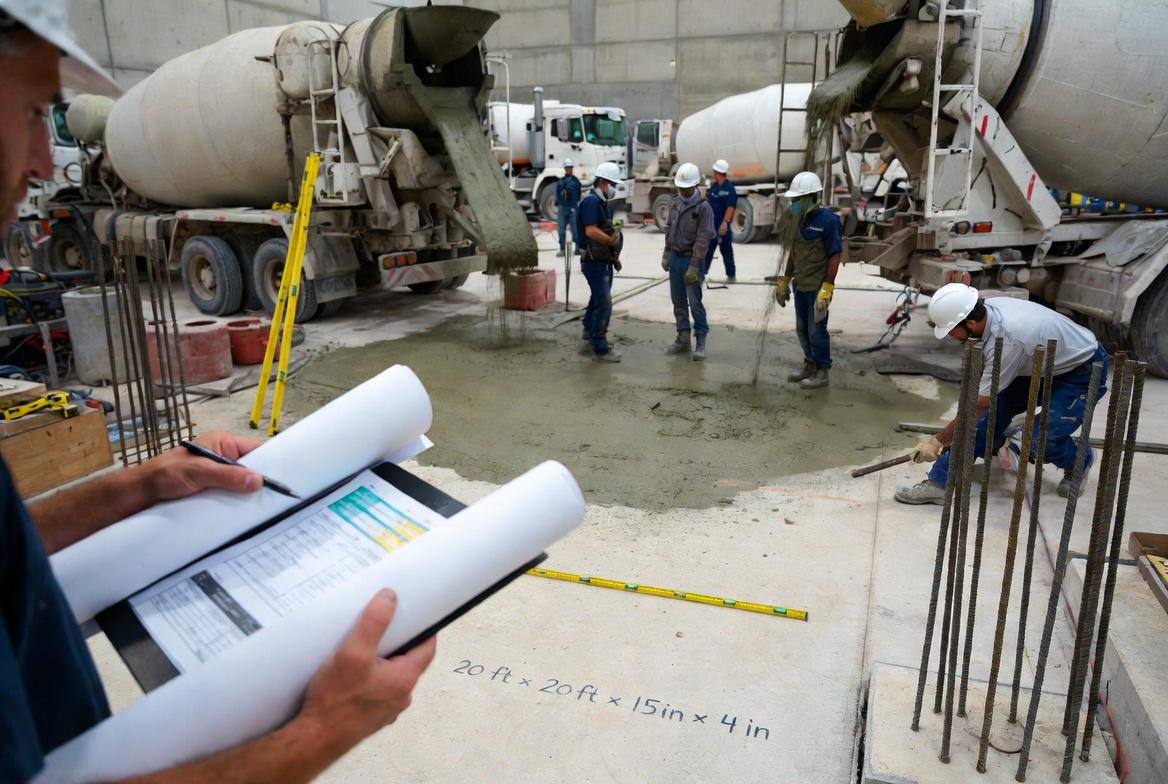
Step-by-Step Guide to Estimating Concrete Yards
One of the most significant aspects of any construction project is concrete estimation.
Ordering less than the required concrete may slow down the work, whereas ordering more than is needed may raise the cost of the project.
Knowing how to correctly calculate concrete yards can assist contractors, builders, and homeowners in making expensive mistakes and staying on schedule with their projects.
What is a Concrete Yard?
Concrete is normally quantified using cubic yards. One cubic yard equals **27 cubic feet** (3 ft × 3 ft × 3 ft). The cubic yards of concrete are the standard unit of order of ready-mix concrete used by the concrete suppliers.
Step 1: Measure the Length and Width
The first step is to measure the size of the area to be covered by concrete.
For example:
- Length = 20 feet
- Width = 15 feet
multiply the length by width to come up with the square feet.
20 × 15 = 300 square feet
Step 2: Find the Thickness
Determine the necessary thickness of concrete.
Common thicknesses include:
- Sidewalks: 4 inches
- Driveways: 5–6 inches
- Patios: 4 inches
- Foundations: Depends upon design.
Convert the thickness from inches to feet.
Example:
4 inches ÷ 12 = 0.333 feet
Step 3: Compute Cubic Feet
Multiply:
Length × Width × Thickness
Example:
20 × 15 × 0.333 = 99.9 cubic feet
Step 4: Transform Cubic Feet into Cubic Yards
As there are 27 cubic feet in 1 cubic yard, we can divide the total cubic feet by 27.
Example:
99.9 ÷ 27 = 3.7 cubic yards
The concrete volume that will be needed in the project is around 3.7 cubic yards.
Step 5: Add Waste Allowance
However, construction projects usually need extra material to consider irregular grades, spillage, and differences in placement.
One of the common suggestions is to introduce 5-10 percent of additional concrete.
Example:
3.7 cubic yards + 10% = 4.1 cubic yards
To make sure that there is enough material, the ordering is 4.1 cubic yards.
Concrete Yard Estimation Formula
Quick computations can be made using the formula below:
(Length × Width × Thickness in Feet) ÷ 27 = Cubic Yards
This simple formula can be applied to slabs, driveways, patios, sidewalks, and many other concrete applications.
Common Mistakes to Avoid
- Incorrect measurements
- Forgetting to change the inches to feet.
- Not including waste allowance
- No attention to irregular forms and heights.
- Making use of rough estimations as opposed to precision takeoffs.
The slightest errors in measurement can have a great influence on cost of the project.
Why Professional Concrete Estimating Matters
Correct concrete quantity takeoff will assist the contractors to enhance the precision of the bids, minimize the wastage of materials and ensure profitability. To estimate the volume of concrete by the professionals, advanced software and comprehensive construction plans are used to get complicated estimates.
At Backus Estimating, we offer concrete estimating services, so that our clients can be confident in their quantity takeoffs used to bid on residential, commercial, and industrial projects and ensure that cost is controlled.
Benefits of Accurate Concrete Yard Estimation
Accurate concrete yard estimation helps contractors and homeowners reduce material waste, avoid project delays, and control construction costs. Proper calculations improve bidding accuracy, ensure smoother project execution, and prevent shortages or over-ordering of concrete materials.
When the concrete quantity is estimated correctly, contractors can schedule labor, equipment, and deliveries more efficiently. It also helps maintain project timelines by reducing interruptions caused by material shortages. Accurate estimates support better budget planning and minimize unnecessary expenses related to excess concrete disposal or additional orders.
Final Thoughts
To plan projects well, it is important to estimate the number of concrete yards accurately. Through correct measurements, use of the right formula and addition of a waste factor, contractors would be able to prevent delays and manage material costs.
For complex projects, professional concrete estimating services may be used to give the accuracy required to allow competitive and profitable bids.