
What Are the Ingredients of Concrete? A Complete Breakdown (2026 Guide)
Understanding Concrete Starts with Understanding Its Ingredients
The modern construction relies on concrete. Whether a home or a business building, bridge, highway, warehouse or skyscraper, almost all of them rely on concrete as a strength and durability factor. However, a question many contractors, builders and property owners raise is, “What are the ingredients of concrete and why does it matter?’’
Concrete might seem a simple gray material but the fact is that it is a well-thought-out combination of multiple necessary components. All these components contribute differently to the strength, workability, durability, setting time and long-term performance of the concrete. The finishing structure can be greatly influenced by even a slight alteration in the proportions.
In this detailed 2026 guide, we will examine the key components of concrete, how each component works to make the mix, the various types of concrete mix ratios and the reasons why concrete estimating, material takeoff services and construction estimating services are required to manage costs and avoid material waste on construction projects.
What Is Concrete?
A Carefully Engineered Building Material Designed for Strength
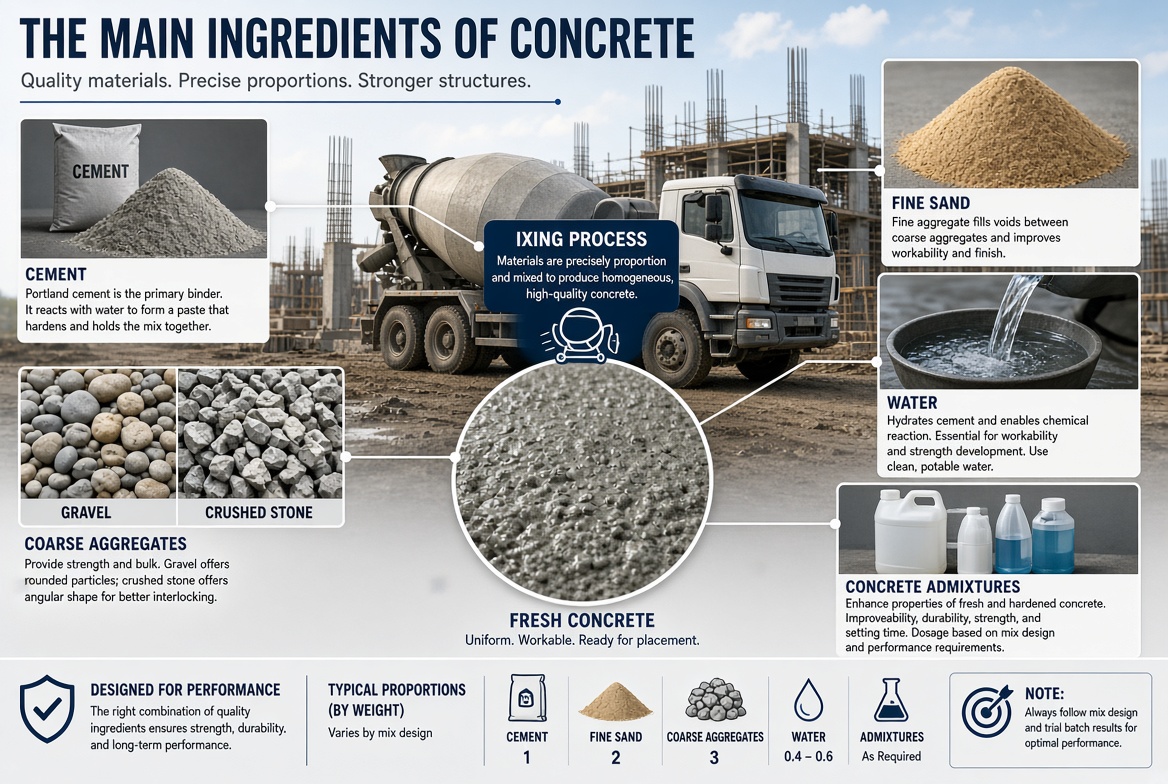
Concrete is a composite building material, a mixture of cement, water, fine aggregates (sand), coarse aggregates (gravel or crushed rock) and in most instances chemical or mineral admixtures. Once these ingredients are combined, a chemical reaction called hydration begins, causing the mixture to harden into one of the strongest and most durable construction materials available.
The contemporary construction sector employs various concrete mixtures based on the structural needs, weather conditions, project size and building codes.
Cement
The Binding Ingredient That Holds Everything Together
Cement is confused with concrete because it is just a component of concrete. It is the adhesive that binds all other materials together in the process of hydration. The Portland cement has all the best qualities of being strong, reliable and versatile and that is the reason why it is mostly used in residential, commercial and industrial buildings.
Compressive strength, curing time and durability directly depend on the quality and quantity of cement. Insufficient cement can make the concrete weak, whereas excess cement can cause more shrinkage, cracking and unnecessary costs incurred in the project.
Water
The Ingredient That Activates the Entire Concrete Mix
Water triggers the chemical reaction that converts dry materials to hardened concrete. Cement cannot hydrate properly without the appropriate quantity of water to enable the concrete to attain the intended strength.
One of the most significant factors concerning the production of concrete is the maintenance of the proper water-to-cement ratio. Water that is not used up causes compressive strength to decrease and cracking to increase whereas too little water causes the mix to be hard to place, compact and finish.
Fine Aggregates (Sand)
Improving Workability and Surface Finish
Fine aggregate also referred to as sand, is a filler that occupies the gaps between the large aggregate particles and enhances the workability of fresh concrete. Smoother finishes, enhanced compaction and increased durability are some of the benefits of high-quality and clean sand.
Concrete performance is affected by the size, cleanliness and grading of sand. Sand of low quality with a lot of clay or organic matter may lower bond strength and predispose defects.
Coarse Aggregates
Providing the Structural Strength of Concrete
Coarse aggregates can be crushed stone, gravel or recycles of concrete to serve the purpose of giving bulk and strength to the mix. These materials minimize shrinkage, enhance carrying capacity and assist in managing total project expenses because aggregates usually constitute the greatest volume of concrete.
The choice of aggregate size varies depending on the design of the structure, the spacing between reinforcing and its position needs.
Chemical Admixtures
Enhancing Concrete Performance for Specialized Applications
Modern construction projects tend to put concrete to test in order to be useful. Chemical admixtures are introduced to enhance certain properties like setting time, workability, water reduction, air entrainment, freeze-thaw resistance and early strength development.
Depending on the project requirements and environmental conditions, contractors usually work with such admixtures as plasticizers, superplasticizers, accelerators, retarders, corrosion inhibitors and waterproofing admixtures.
Mineral Admixtures
Improving Sustainability and Long-Term Durability
Mineral admixtures have gained a critical role in the construction industry because of the attention of the construction industry on the concept of sustainability and performance. Cement is partially substituted by materials like fly ash, silica fume, powdered ground granulated blast furnace slag (GGBFS) and limestone powder which enhance durability, decrease permeability and reduce the environmental impact of concrete production.
These additional cementitious materials also minimize heat production during curing and enhance resistance to chemical attack.
Typical Concrete Mix Ratios
Finding the Right Balance Between Strength and Workability
Different construction projects demand various concrete mix designs. In residential sidewalks, a different mix can be used than in high-rise buildings or bridge foundations. Engineers determine the proper proportions based on structural loads, environmental exposure, workability requirements and durability expectations.
The right proportion of the mixture provide sufficient strength and reduce material wastage and avoidable construction expenses.
Why Every Ingredient Matters
Small Changes Can Have a Big Impact on Performance
The ingredients add something different to the end concrete. Cement gives bonding strength, water is used to activate hydration, sand enhances workability, coarse aggregates give it structural support and admixtures are used to give it special performance. Without any component, contaminated or improperly balanced, the whole concrete construction can experience cracking, low durability, inadequate strength or premature breakdown.
Awareness of these relationships enable the contractors to produce quality concrete and reduce expensive errors.
The Importance of Accurate Material Takeoffs
Estimating the Right Quantities Saves Time and Money
Knowing the ingredients is only part of the process. Contractors should also determine the precise quantity of cement, sand, gravel, water, reinforcement and admixtures that are to be used before the start of construction.
Professional Material Takeoff Services, Quantity Takeoff Services and Construction Takeoff Services help determine precise material quantities directly from construction drawings. Proper takeoffs minimize excess, avoid stock outages, enhance procurement scheduling and save on waste of materials that are not required.
How Construction Estimating Improves Concrete Projects
Accurate Estimates Lead to More Profitable Construction Projects
Professional Construction Estimating Services bring together the quantities of materials with prevailing labor rates, equipment prices and supplier prices to create precise budgets of the project. Quality Cost Estimating Services can help contractors to prepare competitive bids, manage costs, enhance budgeting and increase profitability across the project lifecycle.
Whether it is the construction of residential foundations or a large commercial development, proper estimating will lessen the financial risk and enhance the overall success of a project.
Common Mistakes When Mixing Concrete
Avoiding Errors That Can Reduce Strength and Durability
Numerous real-life failures are due to preventable errors in mixing and placement. Excessive water usage, inappropriate aggregate quality, improper mix ratios, material contamination, improper curing or inadequate compaction may all lead to decreased concrete performance. The selection of materials and quality control must be considered carefully in the production of durable structures.
Choosing the Right Concrete for Your Project
Different Applications Require Different Concrete Mixes
Each construction project has its own performance needs. Different concrete strengths and mix designs are needed in residential driveways, warehouse floors, bridges, retaining walls, industrial foundations and high-rise buildings. Involving skilled engineers, concrete dealers and professional estimators can assist in making sure that the right materials are chosen prior to the start of the business.
The Future of Concrete in 2026
Innovation Is Transforming Modern Concrete Construction
Concrete technology continues to evolve with the introduction of low-carbon cement, self-healing concrete, fiber-reinforced mixes, recycled aggregates, carbon-capture technologies, AI-assisted mix optimization and smart construction materials. These inventions are assisting contractors to enhance sustainability even as they continue to deliver extraordinary structural performance and cost efficiency.
Final Thoughts
Every Great Structure Begins with the Right Concrete Ingredients
Concrete is not as straightforward as it sounds, its effectiveness relies on the proper balance of cement, water, sand, coarse aggregate and admixtures. An awareness of the combination of these ingredients can enable the contractors, builders, engineers and developers to create more robust, safe and durable structures.
Together with professional Construction Estimating Services, Construction Takeoff Services, Material Takeoff Services and Cost Estimating Services, proper planning of concrete materials can be a potent resource in cost reduction, bid accuracy, waste reduction and successful construction projects. Whether it is a home, a business premise or a significant infrastructure, learning the components of concrete is the first step towards construction with security.