
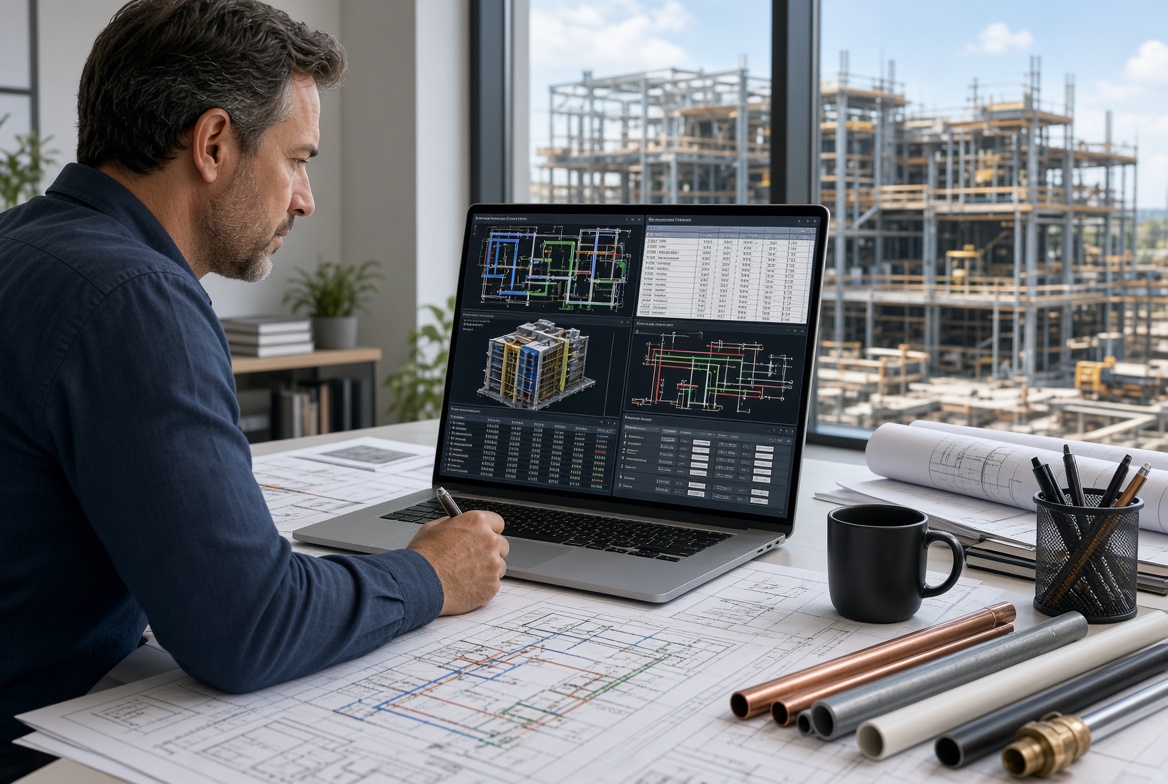
What is MEP Estimating? A Complete Guide for 2026
If you’re a general contractor or subcontractor bidding on commercial projects in 2026, you’ve probably heard the term “MEP Estimating” a hundred times. But what does it actually mean, and why does it make or break your bid?
In short:MEP Estimating is the process of calculating the exact material, labor, and equipment costs for the Mechanical, Electrical, and Plumbing systems of a building before construction starts.
Get it right, and you win profitable jobs. Get it wrong, and you eat the cost.
At Backus Estimating, we’ve prepared thousands of MEP takeoffs for projects across the US, from banks and schools to retail and healthcare. This guide breaks down exactly how MEP estimating works in 2026, what’s included, and how contractors can use it to win more bids.
Breaking Down MEP The 3 Core Systems
MEP stands for 3 major building systems. Every commercial building needs all 3 to function.
Mechanical
This is the HVAC system. Heating, Ventilation, and Air Conditioning.
What we estimate: Ductwork, VAV boxes, exhaust fans, air handlers, chillers, boilers, piping, insulation, controls, and grilles.
Why it matters: Mechanical is usually the most expensive and most complex part of MEP. One missed duct run can cost $10K.
Electrical
This powers the building.
What we estimate: Conduit, wire, panels, breakers, lighting, devices, fire alarm, low voltage, data, generators, and switchgear.
Why it matters: Electrical has the most code requirements. NEC 2023 updates in 2026 made voltage drop and arc fault calculations even stricter.
Plumbing
This handles water in and waste out.
What we estimate: Water piping, sanitary waste, vent piping, storm drainage, fixtures, water heaters, pumps, gas piping, and insulation.
Why it matters: Plumbing takeoffs are detail-heavy. Every fixture, every valve, every hanger needs to be counted.
Together, MEP typically makes up 40% to 60% of the total construction cost. That’s why accurate estimating is non-negotiable.
What Exactly Happens in an MEP Estimating Process?
In 2026, most professional estimators follow a 5-step process. Here’s how Backus Estimating runs it:
Step 1:Plan Review & Scope Clarification
We get your drawings – architectural, structural, and MEP. We review addendums, specs, and bid forms.
Key question: What is included and excluded? Is the fire alarm by EC or GC? Is test and balance included?
This step prevents $50K scope gaps.
Step 2: Digital Takeoff
We use software like AccuBid, Trimble, and Bluebeam to do a digital takeoff.
We count every item: 240 feet of 4″ duct, 18 LED 2×4 lights, 42 plumbing fixtures.
In 2026, AI-assisted takeoff tools are cutting takeoff time by 30%, but human review is still critical. AI misses sleeves, seismic bracing, and code-required items.
Step 3: Pricing & Labor Application
This is where experience wins. We apply current 2026 material costs and labor rates for your state.
We use RSMeans, supplier quotes, and our own historical data. Labor units come from NECA, MCAA, and PHCC manuals.
Example: Running 100′ of 2″ EMT in Texas takes 4.2 man-hours. In New York, it’s 5.1 due to union rates.
Step 4: Cost Assembly & Markups
We build the estimate: Material + Labor + Equipment + Subcontractors + Overhead + Profit.
We also add allowances for waste, shipping, tax, and escalation. In 2026, copper and steel prices are still fluctuating, so escalation is a must.
Step 5: Estimate Review & Bid Submission
Final QA check. We make sure quantities match drawings, specs are met, and the bid form is filled correctly.
You get a clean, line-item estimate you can submit with confidence.
Total turnaround time in 2026: 3 to 7 business days for most commercial projects.
What’s Included in a Professional MEP Estimate?*
A bid that just gives you “1 lump sum” is dangerous. Here’s what a proper 2026 MEP estimate from Backus Estimating includes:
For Mechanical:
- Full material list with part numbers
- Ductwork by size and gauge
- Equipment schedule with tonnage and HP
- Labor hours by system
- Insulation and controls
For Electrical:
- Lighting and device schedule
- Panel schedules and load calculations
- Conduit and wire by size
- Fire alarm and low voltage breakdown
- Permit and testing allowances
For Plumbing:
- Fixture count with model numbers
- Pipe by size and material – copper, PEX, cast iron
- Valves, hangers, and insulation
- Gas piping and water heater specs
- Sewer and storm tie-ins
Plus: Clarifications, exclusions, alternates, and assumptions. No surprises later.
5 Biggest Mistakes Contractors Make in MEP Estimating
We see these every week. Avoid them:
Using Last Year’s Prices
Copper went up 18% in 2025. Labor rates went up 6-8% nationwide. If you’re using old data, you’re losing money.
Missing Scope in Specs
The drawings show 10 diffusers. The specs say “provide sound attenuators on all VAVs.” That’s $12K you didn’t count.
Ignoring Coordination & Sleeves
No one includes sleeves, seismic restraints, and roof curbs in the first pass. But GCs will backcharge you.
Underestimating Labor
A apprentice can’t pull 500 MCM wire the same speed as a journeyman. Labor units must match your crew.
No Contingency for Design Changes
90% of projects have 2-3 addendums before bid. Build in a 3-5% design contingency.
MEP Estimating in 2026: What’s Changed?
The game has changed in the last 12 months:
1. AI + Human Hybrid Takeoffs
Software can now pre-count 70% of items. But estimators still need to verify code items and design intent. Speed + accuracy is the new standard.
2. Material Volatility
Lead times are better, but prices jump monthly. We now include 60-day price locks in our estimates.
3. Stricter Energy Codes
IECC 2024 and ASHRAE 90.1-2022 are adopted in most states. This means more efficient equipment and more controls = higher cost.
4. GCs Want More Detail
General contractors in 2026 want line-item breakdowns, not lump sums. It helps them value-engineer fast.
Why Accurate MEP Estimating Wins More Bids
Let’s be real. The lowest bid doesn’t always win. The most _credible_ bid wins.
When you submit an MEP estimate with clear quantities, current pricing, and clear exclusions, 3 things happen:
1. GC Trusts You They know you won’t come back with change orders in week 2.
2. You Protect Your Margin No missed items no losses.
3. You Bid Faster With a professional takeoff team, you can bid 3x more jobs per month.
That’s exactly what we do at Backus Estimating. We’ve helped contractors win projects like Commerce Bank 2025 by delivering detailed, on-time MEP estimates they could stand behind.
DIY vs Hiring a Professional MEP Estimator
Can you do it in-house? Yes, if you have:
A full-time estimator
- $8K/year in software licenses
- Up-to-date cost data for 50 states
- 3-5 days per bid
For most subcontractors, outsourcing makes more sense. You pay per project, get faster turnarounds, and tap into nationwide pricing data without the overhead.
Final Thoughts: The Bottom Line for 2026
MEP Estimating is no longer just “counting and pricing.” It’s risk management.
In 2026, with tighter margins and stricter codes, an accurate MEP estimate is the difference between a 15% profit and a 10% loss.
If you want your bids to be sharper, faster, and more profitable this year, you need an estimating partner who understands all 3 trades, all 50 states, and the new 2026 codes.
Need a fast, accurate MEP estimate for your next project?
Backus Estimating provides nationwide MEP takeoff and estimating services for contractors. Headquartered in Harrisonville, MO. Serving clients in all 50 states.
Contact us today to get your next bid out on time and on budget.